| Lightning hits the Church! |
WEEK ST. MARY
CHURCH STRUCK BY LIGHTNING
not once, twice, or even
thrice...! |
| According to the most recent
Miscellaneous Register, pertaining to the church of Week
St. Mary, there were several recorded instances of the
tower being struck by lightning. On 8th November
1878 the south-west pinnacle of the tower was
struck by lightning, at 6.45 am, with no record of any
damage caused, if any. Other occasions on which the
tower was struck are recorded as follows: about
1688 the north-east pinnacle struck and during
the winter months of 1812, 1843
and 1865 the north-east, south-east and
south-west pinnacles were struck. |
|
| As
reported by The Cornish & Devon Post |
£2,000
DAMAGE
TO CHURCH |
|
Lightning's Havoc At Week St.
Mary |
PINNACLE
CRASHES
THROUGH ROOF |
| Beams,
Lamps, And Pews Smashed |
|
|
A close
investigation made yesterday revealed
that damage estimated at £2,000 was done
to the ancient parish church at Week St.
Mary, when the tower was struck by
lightning on Thursday afternoon after a
short, but heavy, thunderstorm.
One of the four pinnacles crashed,
portions going through the roof in
several places, and inside the church
oak beams splintered under the weight of
the falling masonry and several of the
oil lamps that illuminate the interior
were smashed to pieces.
The church doors have been locked and
danger notices have been posted around
the churchyard.
It is expected that it will take
something like six months to repair the
church, and in the meantime the parish
services will be conducted in the
rectory hall. |
|
--------------------------- |
STORM UNEXPECTED
Crash Drowned By
Thunder Claps |
The storm came on
with surprising suddenness. About
lunch-time on Thursday the weather was
almost perfect at Week St. Mary. Then,
without the slightest warning, the
village was visited by a sharp thunder
and hailstorm that prevailed in full
force for about 20 minutes, leaving the
highways covered with hail.
For a while no one noticed the damage to
the church amid the noise of repeated
thunder-claps. Eventually, Mr.
Sandercock and his brother, who live
about 200 yards away from the church,
left their house to examine their
bakehouse, upon which a large brick
appeared to have fallen. It was then
that the damage to the church was first
noticed.
Of the four pinnacles at the top of the
church tower only three remained, and
the churchyard was strewn with masonry.
The damaged tower and the gaping holes
in the roof beneath told their own
story, and a glance inside the church
revealed the chaos that the lightning
had caused. |
|
--------------------------- |
| MONSTER
STONE |
Fortunately, there
was no one in or near the church at the
time. The west end of the church
underneath the tower was covered by the
fallen masonry, and one stone weighing
at least a quarter of a ton, had crashed
through the roof and broken several oak
beams. Many oil-lamps and pews (the
latter having been placed in the church
only five years ago) were smashed.
In the churchyard many of the larger
stones had been forced into the earth to
a depth of a foot.
The present rector of Week St. Mary is
Rev. A. Hambrook. The church, which
stands upon the site of a Norman church,
was thoroughly restored in the years
1876-1881, at a cost of over £2,000. The
re-seating of the church in English oak
was begun in 1926, and finished in
January, 1930, at a cost of £600.
|
Reproduced by kind permission of the
Cornish & Devon Post
|
|

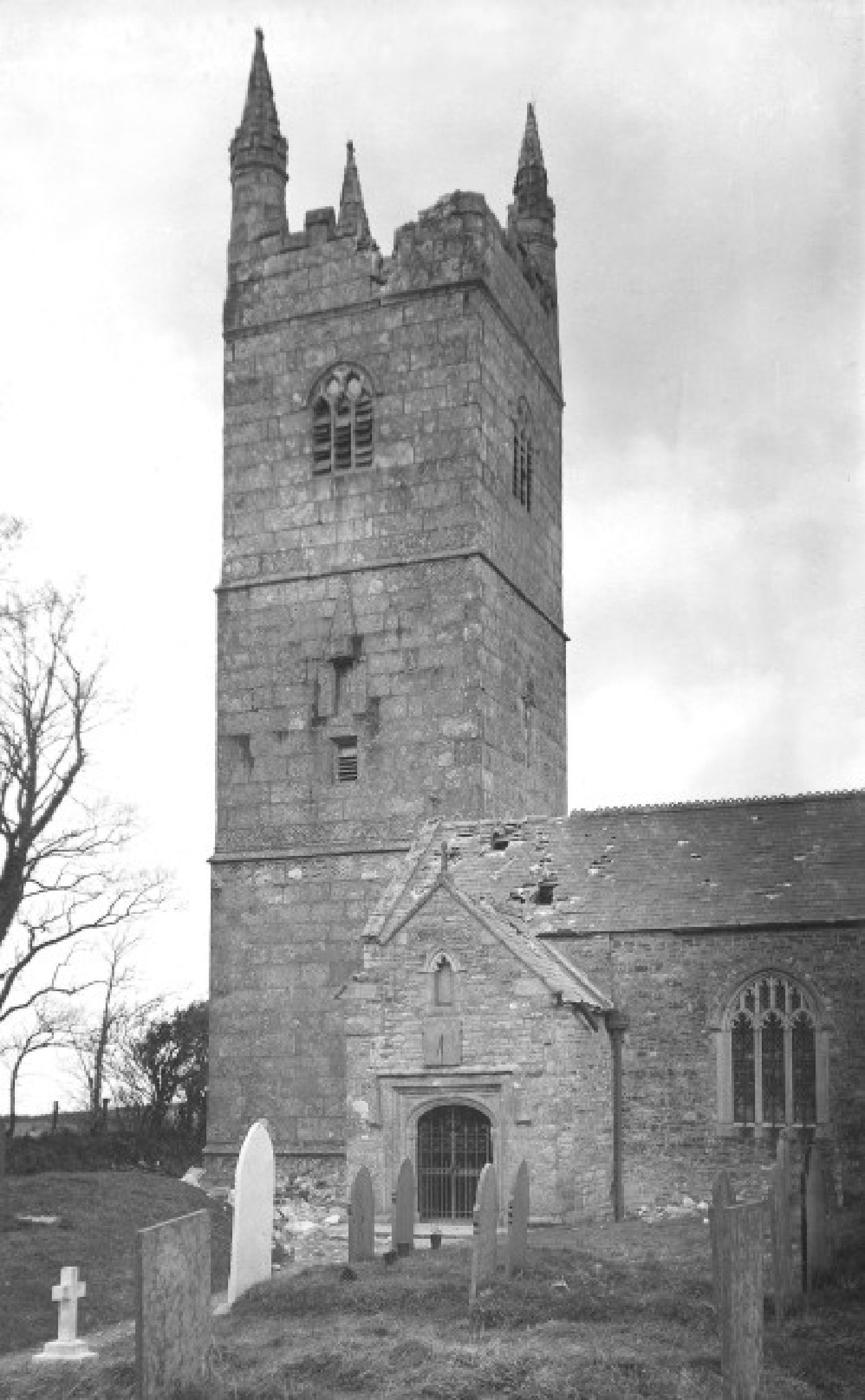
Damage to the porch and roof is
clearly seen in this photograph |
|

After a violent hailstorm at 1.25
p.m. on Thursday 21st February 1935, the south-east
pinnacle of the tower was struck by lightning.

This photograph shows Oswald
Sandercock pointing at the masonry brought down by the
lightning strike.

...and as seen from the inside,
narrowly missing the font
The lightning strike brought down
the south-east pinnacle, causing masonry to crash down
and smash through the roof, causing such devastation
that the church had to be closed. An appeal for funds
was launched immediately and repairs begun. The
opportunity was taken to replace the variegated floor
tiles favoured by the Victorians with stone slabs and
the church was duly re-opened for worship on 16th
January 1936. |

Clearly a very lucky thing
that the church was empty! |
|
| |
|
|