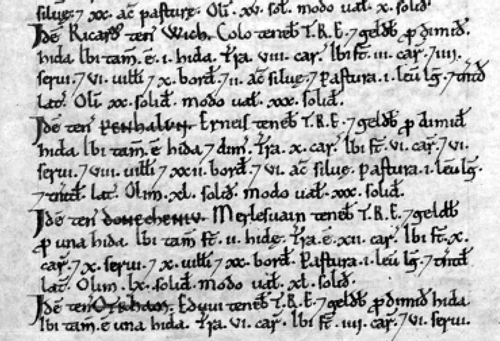
Although difficult to grasp at first it is still noticeable that it mentions quite a bit of ground and a number of people - this shows that the village has already grown to some substance by this period in our history.
Week St. Mary is thus recorded in the Domesday Book as the small settlement of 'Wich' and this manor was granted to Richard Fitz Turold, steward of the Earl of Cornwall, Robert of Mortain, a half brother of William I. The settlement had a recorded occupancy of about six villagers and ten smallholders. This period of our history was apparently quite a bloody one; the military conquest of England by William, duke of Normandy (later William I), was mainly through his victory over Harold II at the Battle of Hastings. Edward the Confessor had designated William as his successor in 1051, so when Harold, duke of Wessex, was crowned king of England in 1066 instead, William assembled an invasion force of some 5,000 knights.
After defeating Harold's army near Hastings on October 14 and advancing to London, he was crowned king in Westminster Abbey on Christmas Day, 1066. Native revolts continued until 1071, notably in Northumbria. The Norman Conquest brought great social and political changes to England, linking the country more closely with Western Europe and replacing the old English aristocracy with a Norman aristocracy. The English language was subjected to a long period of influence by Anglo-French, which remained in literary and courtly use until the reign of Edward III and in legal reporting until the 17th century.
Week St. Mary was allegedly a small, typical medieval market town which served the surrounding countryside; generally of up to half a day's walk away. This ancient borough is noted for the arrangement of 'strip fields' (burgage stitches) radiating outwards from the church and castle. Whilst other examples of strip fields can be found nearby at Forrabury they do not follow the same layout.
It seems probable that for centuries it was a place of some importance in the surrounding countryside. A few fields westward of the present village and church is a flat-topped circular hill known as Ashbury: it is now a field, but all round it can be seen the earth-works which surrounded a prehistoric fortified "bury" ("burgh" or "borough").
Later came the Normans to settle in a hostile country. Anyone coming from the coast, who has seen Week St. Mary church tower persistently pushing itself into view, can imagine a Norman Baron finding hereabouts a good place on which to build his castle. This is what certainly happened. The field adjoining the Churchyard on the west is still known as “Castle Ditch,” and in it is a large mound, which marks the site of an old building, and which from its shape tells us that it was a Norman Castle. Under the shelter of this castle we may suppose was built the Church of “Our Lady of Week” on the same site as the present Church.
The Castle, together with the Manor and Borough of Week, belonged in 1085 to the powerful Baron Fitz Turold, Lord of Cardinham. A member of his house settled here, and about 1171, Osbert, Prior of Tywardreath, with eight of his monks, witnessed a deed by which Walter de Wick and Aliz, daughter of Richard de Wick, granted to the Priory the right of the advowson3 'in the Church of the Blessed Virgin Mary of Wick'. It is plain therefore that the family called “de Wick” took its name from Wick St. Mary.
The monks of Tywardreath did not long retain the patronage, for at an early date the manor of Week came into the possession of the Blanchminster family. Ralph de Blanchminster, of whom there is a monumental effigy in armour in Stratton Church, died in 1348.
That Week St. Mary was still considered a place of some importance may be inferred from the following story:
Richard Buvyle, Rector of the neighbouring parish of Whitstone, died in 1358, slain either by his own hand or by some enemy. He was doubtless buried at cross roads. Rumour had it that he was a saint, and some remarkable cures having taken place at his grave, the body was translated to Whitstone Church. Meanwhile the “cult” of this new saint had taken hold of all North Cornwall and Devonshire. Bands of people kept nightly vigils at the first place of his burial, saying prayers for his soul. These, with the friends who brought them victuals, turned the place into a regular fair, resulting in such behaviour that Bishop Grandisson felt bound to interfere. He ordered the “cultus” to cease until due enquiry into the alleged cures had been made. In 1361, a jury consisting of three vicars, three curates and six laymen was specially summoned at Week St. Mary for the purpose, and they sent to the Bishop a certificate of ten cures performed on five men and five women. After this the matter seems to have died a natural death, for we hear no more about it.
A writer in 1799 says: “The Churchtown is in all ancient records called the Borough of Week St. Mary, and the occupiers of certain fields are still called Burgage holders. The custom of electing a mayor is still kept up, but his office is merely nominal.”
Papers in the possession of the late Col. I'ans show that certain families held different estates by lease, which were tributary to the Crown; and in particular the honour and fee of Week St. Mary was a part of the inheritance of the Duchy of Cornwall. Edward III created the Duchy in 1337 for maintenance of his eldest son, then aged 7 years. Christopher Pollard, Esq., after having granted leases of several burgage tenements, sold the fee to Prince Charles, afterwards Charles I, in a warrant dated February, 1616, and addressed to the free tenants of the Manor of Swannacott and Week St. Mary. In 1637 an order was issued for the steward and bailiff of Week St. Mary to appear “within goat skin mantles” and account before the court.
The descendants of the Blanchminsters and their connections including such famous names as Tresillian, Granville, Earl of Bath, Carteret, continued to be patrons of the Living of Week St. Mary until 1786, when, by agreement with the Master and Fellows of Sidney Sussex College, Cambridge, Lord Carteret exchanged it for that of Wilshampstead, which was close to his family seat near Bedford.
Following on from the Domesday reference the manor of Week St. Mary was held by the De Wyke family, then, during the 13th century the village passed to the Blanchminster family. The seaside town of Bude, just seven miles northwest of Week St. Mary still has a number of properties owned by the Blanchminster Trust.
The major components of the ancient borough are the church, 'castle' and the market site. The ruins of this castle located in the field adjoining the church and locally named Castle Ditch, would almost certainly have been of wooden construction. Nothing but distinct mounds are visible suggesting ancient ramparts although there is no evidence that the castle played host to any attacks! The earthworks represent a 11th or 12th century castle and reportedly it would have failed to gain any significance past the 14th or 15th centuries.
The church stands on the site of an earlier Norman church - the 99ft tower stands high and mighty and can be seen from so many vantage points of the surrounding countryside. Whilst mostly of 15th century construction there is evidence of 13th and 14th century work.
Thomasine Bonaventure: Much has been written of this woman. Many of the stories that have been passed down through the generations dwell on the romantic element of the story whilst others pooh-pooh the whole story giving it a totally different slant. The Dictionary of National Biography has registered a version in that it seems that some of the tales about her early life are incorrect and she belonged to the gentry and was not a poor shepherd's daughter.
One of the best 'popular' versions is that of the following, from "A Romance of Week St. Mary". In the year 1463, in the reign of King Edward IV, a London merchant, accompanied by his serving man, was crossing the moors to the south of Wyke St. Mary, and, seeking shelter for the night, met a maiden looking after a few sheep. This event was in the general area of Greenamoord1. At the stranger's request she took him to her father's humble home, and there the wayfarer stayed that night. Next morning Richard Burnsby, for such was his name, having been greatly impressed by their daughter's wit and beauty, asked the parents if he might take her to London to assist his wife. So Thomasine Bonaventure set off, travelling pillion behind her master's servant, and in a fortnight's time was riding through the streets of London town, which one day were to ring with the praises of this unknown village maid. After Thomasine had spent a few years as a capable and faithful serving maid, her mistress died, and she consented to become the wife of her master.
Three years afterwards her husband died of the plague, leaving to his wife - a young and beautiful widow - the whole of his property. In one of her letters she announces her husband's death and gives the Reeve of Week St. Mary ten marks “to the intent that he shall cause skilful masons to build a bridge at the Ford of Green-a-more, yea, and with stout stonework well laid, and see that they do no harm to that tree which standeth fast by the brook, neither dispoyle they the rushes and plants that grow thereby: for there did I pass many goodly hours when I was a small mayde, and there did I first see the face of a faithful friend.”
An old chronicler says: “Her dower, together with her youth and beauty, procured her to the cognizance of divers well-deserving men, who thereupon made addresses of marriage to her, but none of them obtained her affection, but only Henry Gall of St. Lawrence, Milk Street, an eminent and wealthy citizen, and a merchant adventurer.”
Soon after their marriage we find that “twenty acres of woodland copse in the neighbourhood were bought and conveyed by the gracious lady Dame Thomasine Gall to feofees and trustmen, for the perpetual use of the poor of Week St. Mary, for fewel to be hewn in pieces once a year and finally and equally divided, for evermore on the vigil of St. Thomas the Twin.”
After five years Henry Gall died, leaving his wife a great fortune, and it is written, “The fame of the virtue, wealth and beauty of the said Thomasine spread itself over the City of London, so that persons of the greatest magnitude of wealth and dignity there courted her, Among the rest it was the fortune of John Percyval, Esquire, goldsmith and userer (that is to say, banker) to prevail upon her to become his wife.” He was very wealthy and of high repute, alderman of his ward and of noble character. Their wedding, about the year 1480, was made a kind of public festival. As a wedding gift of remembrance to her old home she directed that “a firm and stedfast road should be laid down with stones, at her sole cost, along the midst of Green-a moor, and fit for man and beast to travel on with their lawful occasions from Lanstephadon (Launceston) to the sea.”
At another time she gave forty marks towards the building of a tower for St. Stephen's Church, above the causeway of Dunheved, and it was her wish “that they should carry their pinnacles so high that they might be seen from Swannacote Cross, by the moor, to the intent that they who do behold it from the Burgage Mound may remember the poor mayde who is now a wedded dame of London Citie.”
In 1486 John Percyval became Sheriff of London, and in 1498 Lord Mayor, and was knighted by the King.
With the church and market area paired together at the northern end of the village it shows the strength and importance of each to the community both in the past and more recent centuries. The relatively recent demise of the cattle market has not detracted from the main Square being the natural assembly point for many village functions.
Described in 1820, Week St. Mary, or St. Mary - Week, situated in the Hundred of Stratton and Deanery of Trigg-Major, just seven miles south of Stratton; about ten miles north-west of Launceston, which is the post-office town; and ten west of Holsworthy in Devonshire. The principal villages in this parish, exclusively of the church-town, are Bakesdown, Lower Exe, Kitsham and Week Orchard. These names are now only classed as 'areas' lying within the parish boundary.
The manor of Week St. Mary belonged at an early period to the Blanchminsters, from whom it passed to the Coleshills. In the process of time, the manorial rights were transferred from Week St. Mary to Swannacott; for in 1620 we find that Sir Warwick Hele held the manor of Swannacott, and Week St. Mary Burgh, as parcel of the same. The manor of Swannacott, including Week St. Mary, is now (written in 1820) the property of the Right Honourable Lord de Dunstanville, by inheritance from the Heles.
The surrounding properties in the parish include the manor of Marrais, or East-Orchard-Marrais and Marham Church, which belonged to the ancient Marrais family whose heirs married an ancestor of the Rolle family. Subsequent sales now finds Marhayes as a private dwelling. A licence for a private chapel was granted to the Lord of Marhays and in 1727 the estate of Marhays was responsible for the upkeep of an altar in the south aisle of the church.
In these more modern times the village has been a thriving place, but, as is typical of so many small villages, that independence has been eroded by the availability of supermarkets and the 'instant purchase' options of the internet. Over the past 50 years this has seen most of the local industry almost totally gone, except for the local village shop & Post Office and a small handfull of other businesses.
Despite that, the village has a strong record of 'community action' and this is demonstrated by the number of clubs and the following that they draw from the surrounding area.